Please note: This page is intended for healthcare professionals only. It is designed as a general educational guide and does not replace local guidance, senior clinical advice, or individual clinical judgement. Patients should not use this page as medical advice and should seek advice from an appropriate healthcare professional.
Artificial Urinary Sphincter (AUS)
What is AUS?
- A mechanical continence device used mainly for severe male stress incontinence (usually post-prostatectomy)
- Also used in selected women with severe intrinsic sphincter deficiency when other treatments (slings, colposuspension, bulking) have failed
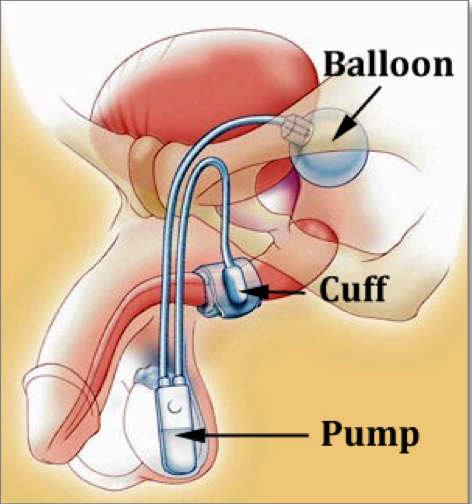
- Components:
- Cuff (urethral or bladder-neck cuff)
- Pump (scrotal/labial) – this has a BULB and BUTTON
- Abdominal pressure balloon (reservoir)
- Connected by tubing
- In women, pump and tubing may be less obvious — maintain high suspicion. Female AUS is less common and usually performed in specialist centres
1. AUS anatomical position
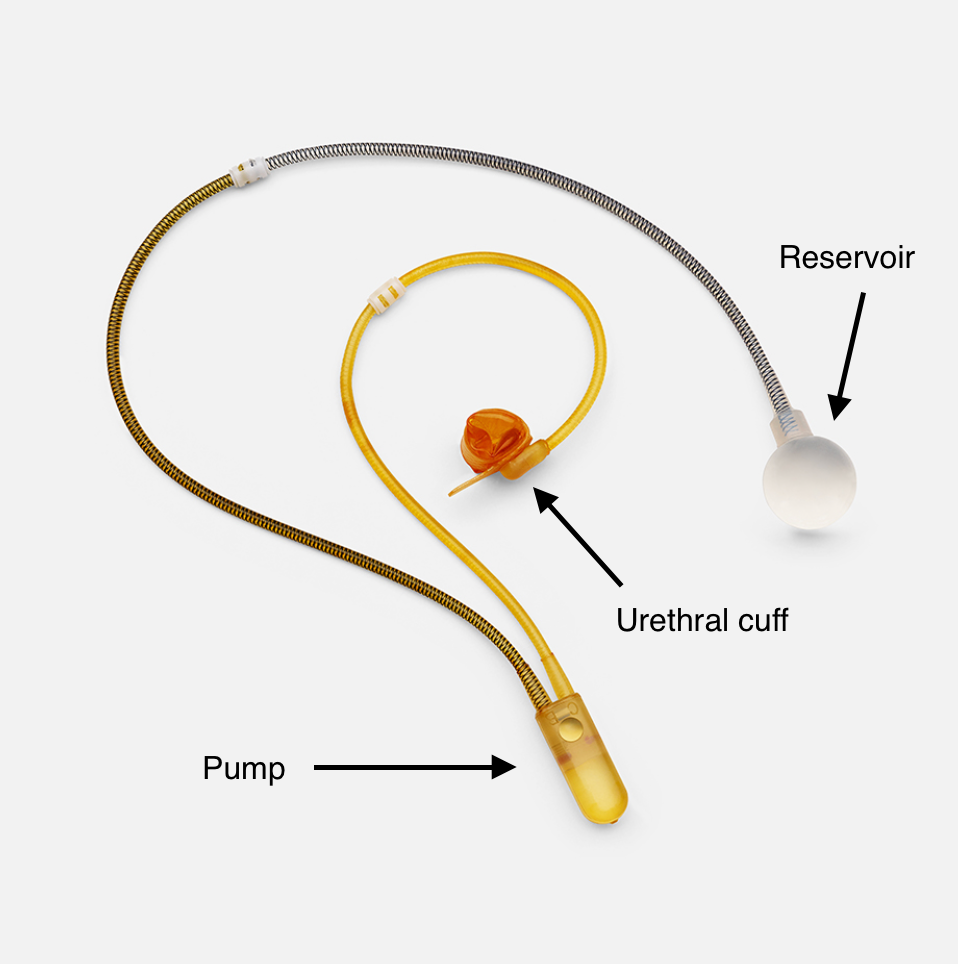
2. AUS device components
CRITICAL SAFETY FOR SHOs
If the patient presents with urinary retention
- The AUS must be fully deactivated first to prevent cuff injury, urethral transection, or erosion
- If patient conscious ask patient to deactivate it
- Patient will often also carry a device card or written instructions
- If unsure whether the device is activated → STOP and contact the urology SpR/consultant immediately.
Emergency Deactivation
- Ask the patient to deactivate the sphincter
- If patient unconscious or unable due to any reason:
- Only attempt deactivation if familiar with the device or under direct urology guidance. If unsure, stop and contact Urology SpR/consultant
- In general steps are:
- Locate the pump (scrotum in men, labium majus in women)
- Compress the soft BULB 2-3 times until you feel a dimple
- Wait for 30-60s to allow partial refill
- Then press and hold deactivation BUTTON for 1-3 seconds
- After 90s if dimple remains then AUS is deactivated; if not – repeat cycle
- If you cannot confidently deactivate → do not attempt catheterisation, there is always help, call SpR
Link to YouTube video on AUS deactivation (also called cycling):
Catheterisation AFTER safe deactivation
- Use 10–12 Fr catheter
- Generous lubrication + insert gently
- Stop immediately at any resistance
- If unsuccessful → call senior, consider flexible cystoscopy or SPC.
Caution During Scrotal / Perineal / Labial Surgery
- AUS tubing runs through the scrotum (men) or labia/perineum (women) to the pump
- High risk of accidental tubing injury during:
- Hydrocele repair
- Scrotal exploration
- Labial/urethral surgery
- Perineal incisions
- Be mindful of blind SPC insertion as it may catch the abdominal component of sphincter – SPC will require radiological guidance
- If an AUS is present → discuss with Urology SpR or consultant before any incision