Inventor of the Hamilton Irving Box
 Hamilton Irving was born in Huddersfield on 15th February 1877. His father, John Irving (1855 – 1941) was GP, his mother Fanny Irving nee Watkinson (1848 – 1881) was also from Huddersfield. He was initially schooled at Huddersfield College then in 1891, he went on to Sedbergh School, a public school in Cumbria. He subsequently went to Owens College in Manchester, later to become the Victoria University of Manchester, to study medicine. At the Medical School at Owens, Irving’s talent as an artist can be seen in the cartoons he sketched for the Manchester Medical Student’s Gazette.
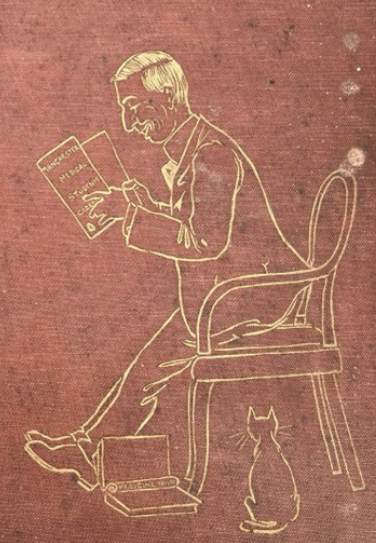
The image on the left is thought to be of Irving and illustrates the cover of his 1904 book of sketches on university life.
He qualified from Manchester in 1904 and was a House Surgeon at the Manchester Royal Infirmary, he then became House Surgeon and House Physician at the Evelina Hospital for Sick Children in Southwark, London. He subsequently became Senior House Surgeon at St Peter’s Hospital for the Stone in Covent Garden, the first specialist urology Hospital.
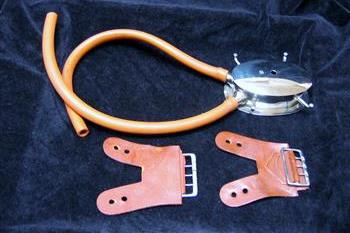 At St Peter’s, Sir Peter Freyer (1851 – 1921) was carrying out open transvesical prostatectomy. Following the surgery, the bladder was drained using a large suprapubic tube, the urine and blood being soaked up by dressings on the abdomen. These were changed regularly by the nurses who also tried to protect the skin with liberal applications of zinc paste. Irving, whilst working at St Peter’s devised a device to collect the urine and minimise the inconvenience to the patient and the nurses. It consisted of a box (Irving describes it as like a straw hat), made of cellulose (an early plastic) which was strapped over the suprapubic tube and drained by two spouts at the bottom via rubber tubes into a bottle by the patient’s bed. He published his design in the Lancet in 1907. Freyer endorsed it in the Lancet paper and also in his 1908 book on surgical diseases of the urinary organs where he describes Irving as his friend. See more examples here.
In 1909, Hamilton Irving established his private practice in London and married Ruth Monica Browngold on 9 September 1911 they lived at 72 Wimpole Street. He was also a medical advisor to the Sun Life Insurance Company to assess accident claims and a medical officer to the London County Council on the education committee.
During the First World War Irving was commissioned as a temporary Major in June 1915 to work at the Brook War Hospital on Shooters Hill, Woolwich. He relinquished his commission on 1st July 1919, after teh war, retaining the rank of Major but continued to help as medical specialist to the London Pension Appeal Board.
Hamilton Irving retired in 1930 and moved to Henley on Thames where he died on 27th February 1932. He was buried in Edgerton Cemetery in his hometown of Huddersfield.
← Back to Famous Clinicians Room